

by Molly Brown
Recorded by author

The theme for this September 2023 issue, Metabolizing Grief to Nurture the Great Turning, grew out of confronting the many tragedies and injustices we on the editorial team (and everyone we know) are experiencing or witnessing today, and our struggle to honor and work with our grief in response to it all. Our team was inspired by a quote from Martin Prechtel that one of our members brought to us: “Metabolize your losses with grief and feed the resulting beauty to life.” We can metabolize our pain for the world–in other words: process, digest, break down, and convert that pain into energy and wisdom–and thereby nurture the Great Turning.
We received a cornucopia of submissions, more than for any previous issue, with an abundance of poetry. Then we faced the very challenging task of choosing what to include in this issue; we had to consult our submission guidelines again and again in making our decisions. Please know that in addition to the heart-felt poetry and essays you find here, there were many more worthy submissions–some of which we may bring to you in future issues.
We share here essays and poetry that interweave experiences of loss, trauma, and grief with the effects of fully experiencing them, acknowledging and celebrating the courage, perseverance, and wisdom that grows with deepening awareness of the transformative beauty of our feelings, other beings, and our world.
Gratitude can emerge in the midst of pain and loss, as the first stage of the Spiral suggests. A poem by Susan Solinsky on the Buddhist practice of “Tonglen” introduces this section, followed by k.c.klein’s personal essay “Radical Gratitude in the Redwoods” and Katharine Burke’s reflections on “What Beans Tell Us.” A poem by April Tierney, “A Progeny of Love,” reminds us of the close relationship between love and grief, guiding us into the next stage of the Spiral.
To Honor Our Pain for the World and metabolize it, we need to recognize and express it. Amelia Brady’s poem, “Burning River,” cries out about an environmental horror. Skye Cielita Flor & Miraz Indira’s essay, “The Joyful Lament: On Pain for the World,” explores how the capacity to be with our sorrows in community can bring people back to life, to tend to it again. In her poem, “Lament of the Bones,” offered in English and Hebrew, Osnat Lev Ari decries the ways we separate ourselves from nature, even in death.
Yulia Smagorinsky’s essay “The Global Scale of Metabolizing Grief” suggests how releasing our pain to Earth could support Earth’s regeneration. Juliana Diniz explores how people’s seeming indifference to the suffering in the world is actually a defense against strong, painful emotions in “A Vote of Confidence in Human Goodness.” Kert Lenseigne’s poem, “holy communion,” serves as a benediction to this stage of the Spiral.
Joshua Davies’ poem, “In My Undoing” carries us into Seeing with New (and Ancient) Eyes. Beloved Elder in the Work That Reconnects John Seed offers his reflections on “Hearing, Inside Ourselves, the Sounds of the Earth Crying,” while another long-time facilitator of the Work, Barbara Ford, honors uncertainty in her essay and poem, “The Empty Bowl and the Alchemy of Uncertainty.” In “Realigning with Life,” NVC visionary Miki Kashtan shares a series of conversations about needs, impacts, resources, and choice. Stephanie Yuhas writes about a magical, transformative Council of All Beings at Naropa University in “A Wake-up Call.” Matt Streit explores how “Embracing Extinction and Stubborn Optimism” can free us to act on behalf of life, and Molly Fisk closes this section with her blessing poem, “Explanation.”
Going Forth opens with a poem by Tet Koffeman, “we practised to love all the people.” In “Metabolizing Grief in Mental Health: A Provider’s Perspective,” Sara Thorsen and Krista Gaston tell about their collective of mental health professionals facing the challenges of global crises. The second part of an interview with Michael Wellman focuses on “Resistance, Reskilling, and Re-Membering” as dimensions of the Great Turning. In her essay and poem “Lighting a Candle,” Judy Myerson proposes a simple practice to bear witness to our collective grief, while Barbara Whitfield shares her practice, “On Taking a Poem for a Walk.” Nicholas Tippins offers us eleven “Ways of Grieving” in a concluding poem.
Evolving Edge features a “Letter to Facilitators” by Priyal Shah, helping us all to see how the Work That Reconnects has inadvertently created spaces of marginalization, exclusion, and oppression–and what we can do about it!
In our Resources section, Anna Switzer offers a new practice, “Wander with a Question.” Allie Picketts shares “A Song that Reconnects,” the lyrics of which came to her during a five-week online Work That Reconnects workshop. Karina Lutz recommends three poems on the Web that relate to our theme: Jeff Conant’s “Bestiary for the End Times,” Ugandan artist Maya Adams’s visual poem “Climate Changed,” and Natalie Diaz’s “Alchemy Horse.”
And the Network News section introduces a new Weaver and announces the upcoming Gaian Gathering.
We hope you find food for heart, mind, and soul in this issue, as together we metabolize our grief (and rage and fear and despair) for the world to nurture the Great Turning to a life-sustaining, just, and thriving world for all humans and all life.


WTR Network
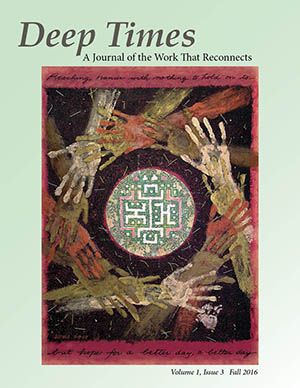
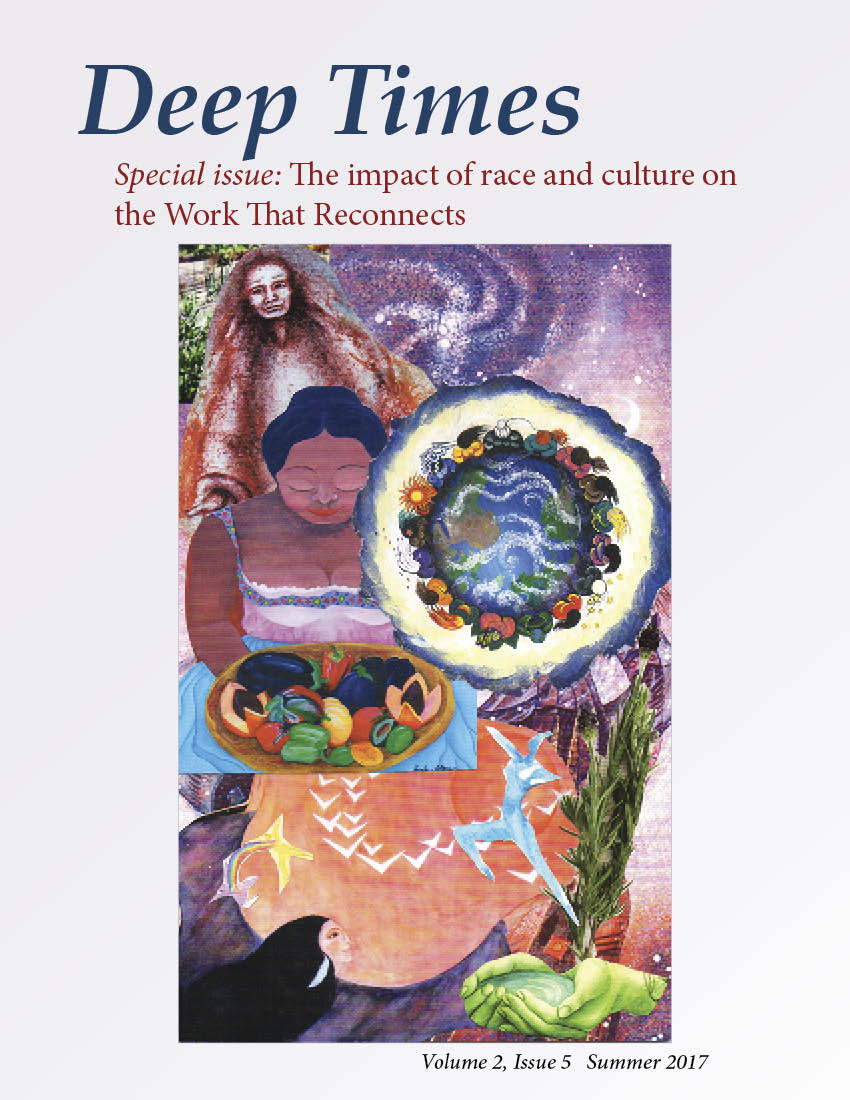
Deep Times: A Journal of The Work That Reconnects
Vol. #9 Issue #2 – September 2023
Editor: Molly Brown
Editorial Team: Carmen Rumbaut, Karina Lutz (poetry editor), Kevin Lay, Rebecca Selove, Carolyn Treadway, Erin Holtz Braeckman and Silvia Di Blasio. More about the team here.
Graphic Design: Frieda Nixdorf
Webmaster: Silvia Di Blasio
Deep Times is published online twice a year by the Work That Reconnects Network.
The Network provides support, guidance, and inspiration to people all over the world in their work for the Great Turning. We welcome your donations to support the Work That Reconnects Network and Deep Times. The Work That Reconnects Network is currently a fiscal project of Inquiring Systems, Inc. so all donations are tax-deductible.
Licensed under Creative Commons Attribution-Non-Commercial-ShareAlike 4.0.